The Newt
Reading ‘The Lost Words’ by Robert Macfarlane and Jackie Morris

The page I return to most often in The Lost Words is the one devoted to the newt.
The two-page spread shows a coot standing on a small rock above the water’s surface. Below the surface, the newt rises through the pale wash of the page, its indignant gaze fixed on the bird.
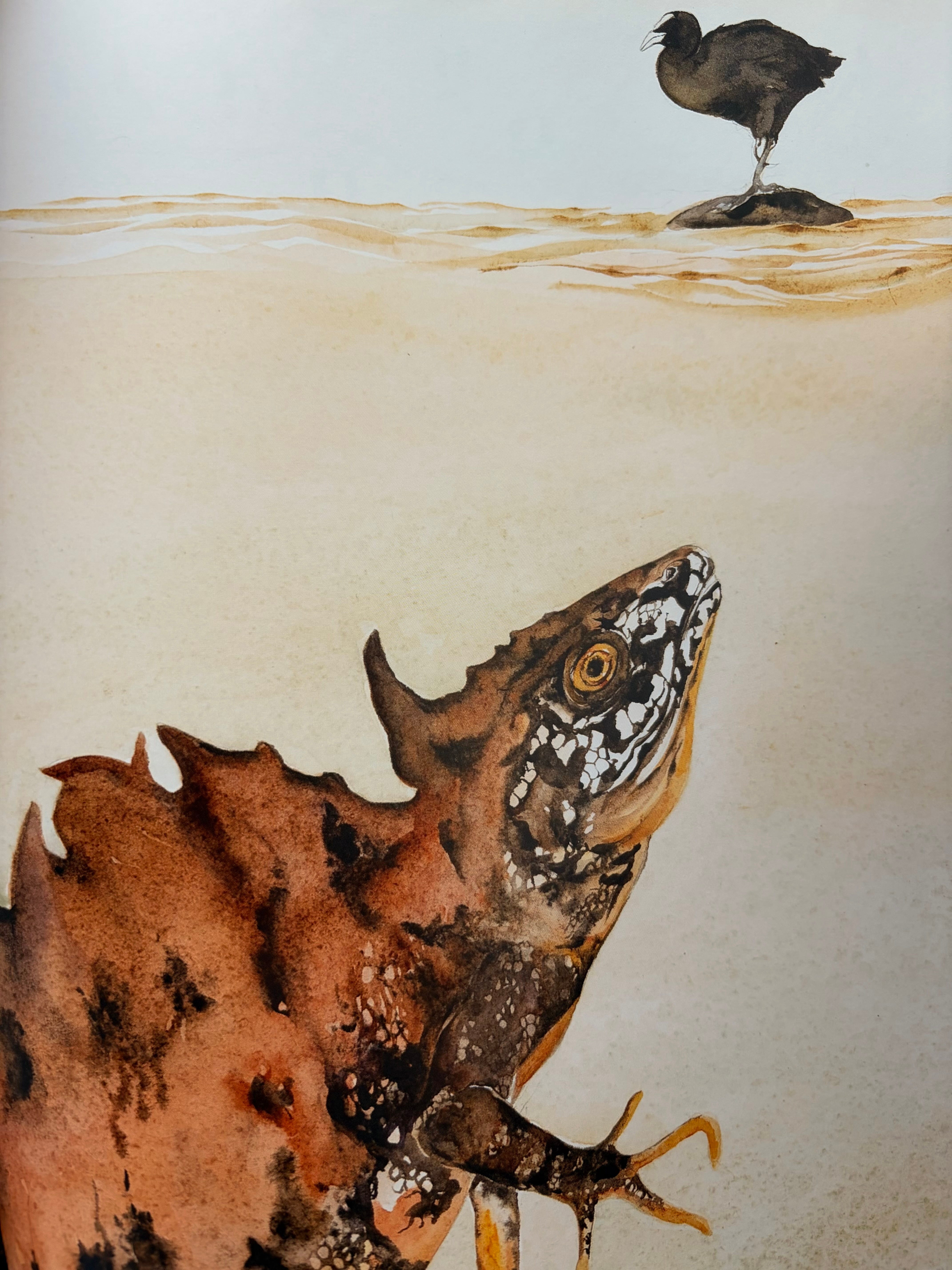
Credit: Jackie Morris, illustrator, The Lost Words, 2017
The poem begins:
‘Newt, oh newt, you are too cute!’ Emoted the coot to the too-cute newt,
With your frilly back and your shiny suit and your spotted skin so unhirsute!’
‘Too cute?!’ the newt roars. Newts are not cute, it insists. They are kings of the pond, lions of the duckweed, dragons of the water, before the newt pauses and mutters, ‘albeit…minute.’
The exchange is humorous, but it changes the way you look at the creature on the page. The newt is no longer just something to glance at and move past. It has presence, and a strong personality.
And so, you begin to notice the details.
The curve of the head.
The texture of the skin.
The delicate edge of the frill.
Jackie Morris gives the animal space. The page is wide and almost empty. There is no background scene, no rush of action. The newt occupies the page on its own terms.
Moments like this help understand what the book is trying to do.
The Lost Words appears to have grown out of a change to a children’s dictionary. Several nature words were removed from a children’s edition, including acorn, bramble, kingfisher, and newt. Robert Macfarlane responded by writing a book of spells intended to conjure those words back. The result is a book that moves from word to word across the natural world.
Through poem and illustration, Macfarlane and Morris attempt to restore not only the words, but the attention those words once carried.
Adults often read picture books too quickly. A page turns, a sentence finishes, the story moves forward. The Lost Words slows that movement. The poems are meant to be spoken. The illustrations invite careful looking.
You repeat the word.
You look again at the animal.
Reading the book with children leads to simple questions.
What does a newt look like in real life?
Where would you find one?
Has anyone ever seen one?
At that point the book begins to point outward. The word leads beyond the page.
A child who has just read about a newt may begin looking for one in a pond or a stream. A word like bramble may draw attention to a tangle of thorns along a path. The language sends the reader back into the landscape it describes.
Picture books often work this way. They draw attention to things that might otherwise pass unnoticed. The Lost Words does this more deliberately.
It suggests that words help us see.
To say the word newt is to imagine the small creature beneath the surface of the water.
Sometimes bringing a word back simply means looking again.